

"How cannulation and circuit connection link to pressure and flow management within a complete competency program"
ECMO competence requires more than knowing the circuit or learning to insert a cannula. Practitioners must bring cognitive knowledge and psychomotor skills together with patient-circuit assessment, emergency response, teamwork, supervised clinical experience, and continuing assessment. No single simulator can build that competence on its own.
A simulator creates value within this larger program by giving learners a controlled setting in which they can act on a patient, use relevant equipment, observe the result, and repeat the experience. For physical and hybrid ECMO simulation, the most useful representation of the patient is therefore a responsive patient-circuit system. It should allow actions involving anatomy, cannulas, and the circuit to produce observable and clinically meaningful changes.
This perspective changes platform selection. The main question is not which simulator has the most features or the highest fidelity label. It is whether the platform enables the intended learner to perform the required task, interpret the resulting patient and circuit response, and improve through repeated practice.
ECMO Competence Is Built by a Program
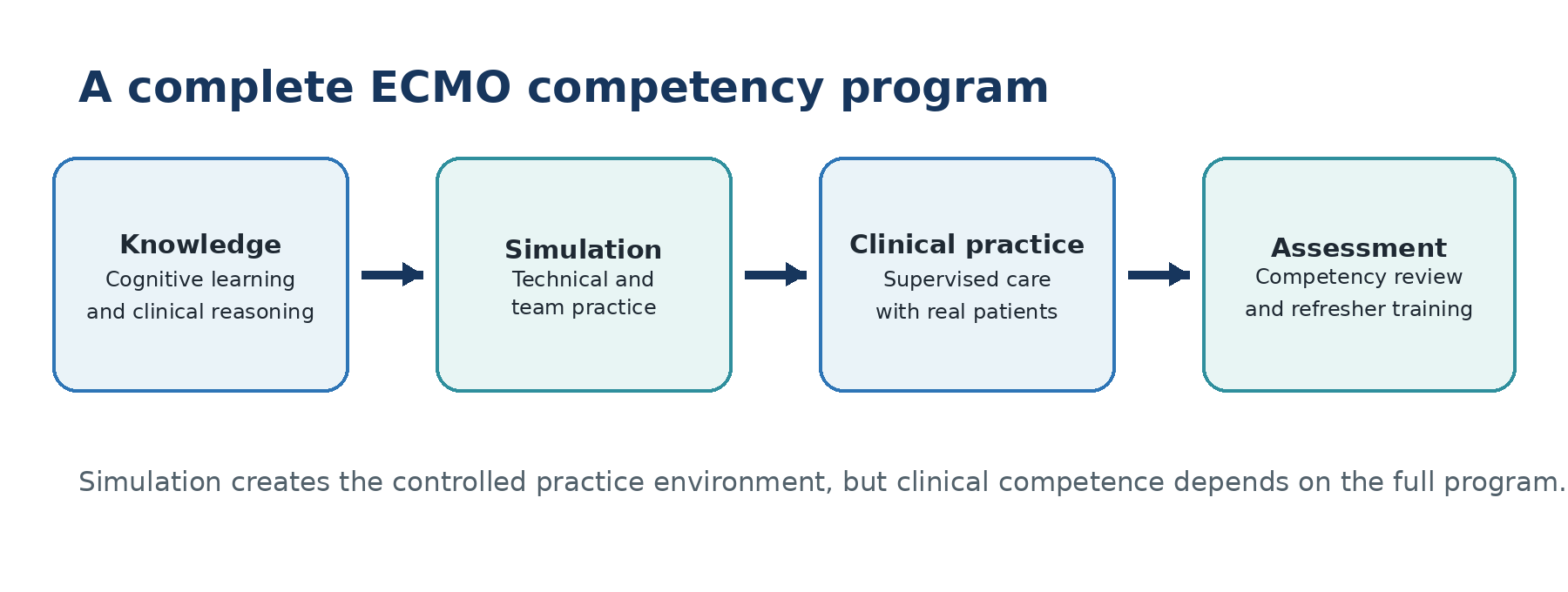
Current Extracorporeal Life Support Organization guidance places didactic learning, simulation, proctored clinical hours, independent practice, and continuing education within one training pathway. The ELSO Center Certification Blueprint also distinguishes hands-on simulation from demonstration: each learner should engage directly, receive multiple opportunities to perform the skills, and use equipment that resembles the clinical environment where possible.
This division of roles matters. Courses and digital resources can teach circuit components, physiology, indications, and clinical reasoning. Simulation can develop technical actions, interpretation, communication, and coordinated response under controlled conditions. Supervised patient care then connects these capabilities to clinical practice. Simulation can supplement limited exposure, but it does not replace active clinical experience.
The Simulator Provides a Patient Circuit System
A simulated patient does not need to reproduce every feature of a full human body. For ECMO training, its value depends on whether it supports the interactions that determine performance. Learners need to move from ultrasound-guided access through guidewire and cannula placement to circuit connection and flow establishment, then recognize abnormal responses and coordinate the next action with the team.
A 2023 scoping review proposed evaluating ECMO simulators through definition-based, component, and customization fidelity. The practical lesson is that fidelity is multidimensional. A model may provide realistic cannulation but little patient or circuit variability. A computational system may model hemodynamics but provide no physical access or real-device interaction. A program should inspect the dimensions that matter to its objectives instead of treating low, mid, and high fidelity as a simple ranking.
This also explains why a portfolio of tools may work better than one complex system. A focused trainer can support high-volume practice of an early skill. An integrated patient-circuit platform becomes more valuable when the learner must connect procedural actions with system behavior, clinical interpretation, and team response.
From Cannulation to Functional Circuit Connection
Cannulation training often concentrates on ultrasound-guided access and the Seldinger sequence. Those skills are essential, but establishing ECMO support continues after the cannula enters the vessel. The learner must determine whether the cannula is serving drainage or return, connect it to the correct circuit limb, establish the intended configuration, initiate support, and confirm that the system behaves as expected.
A platform that connects these stages must first reproduce the procedural pathway. Relevant femoral and jugular anatomy, useful ultrasound imaging, repeatable vessel behavior, and compatibility with the guidewires and cannulas used in training allow learners to practice access and placement. The vascular pathways must then support the VV, VA, or selected hybrid configurations included in the curriculum and connect to the clinical circuit and console used by the team.
The result must also be observable. Learners need visible or measurable cues that help them assess cannula position, flow establishment, and the consequences of an incorrect placement or connection. Without that feedback, the platform can rehearse individual movements but cannot connect them to a functioning ECMO system.
The continuity between these steps is more important than feature count. When cannulation and circuit connection occur on unrelated trainers, learners may perform each task correctly without seeing how access, cannula choice, position, configuration, and connection affect the resulting support. A patient-circuit platform can preserve that relationship.
The main engineering tradeoffs are also practical. Vessel feel must be balanced against durability and replacement cost. Ultrasound appearance must remain useful after repeated punctures. Compatibility with real equipment increases clinical relevance but may raise consumable and setup costs. A translucent structure may sacrifice some cosmetic realism while improving instructional visibility of the vascular pathway, cannula position, and circulation. The right choice depends on what the learner must see and do.
Pressure and Flow Turn Actions into Consequences
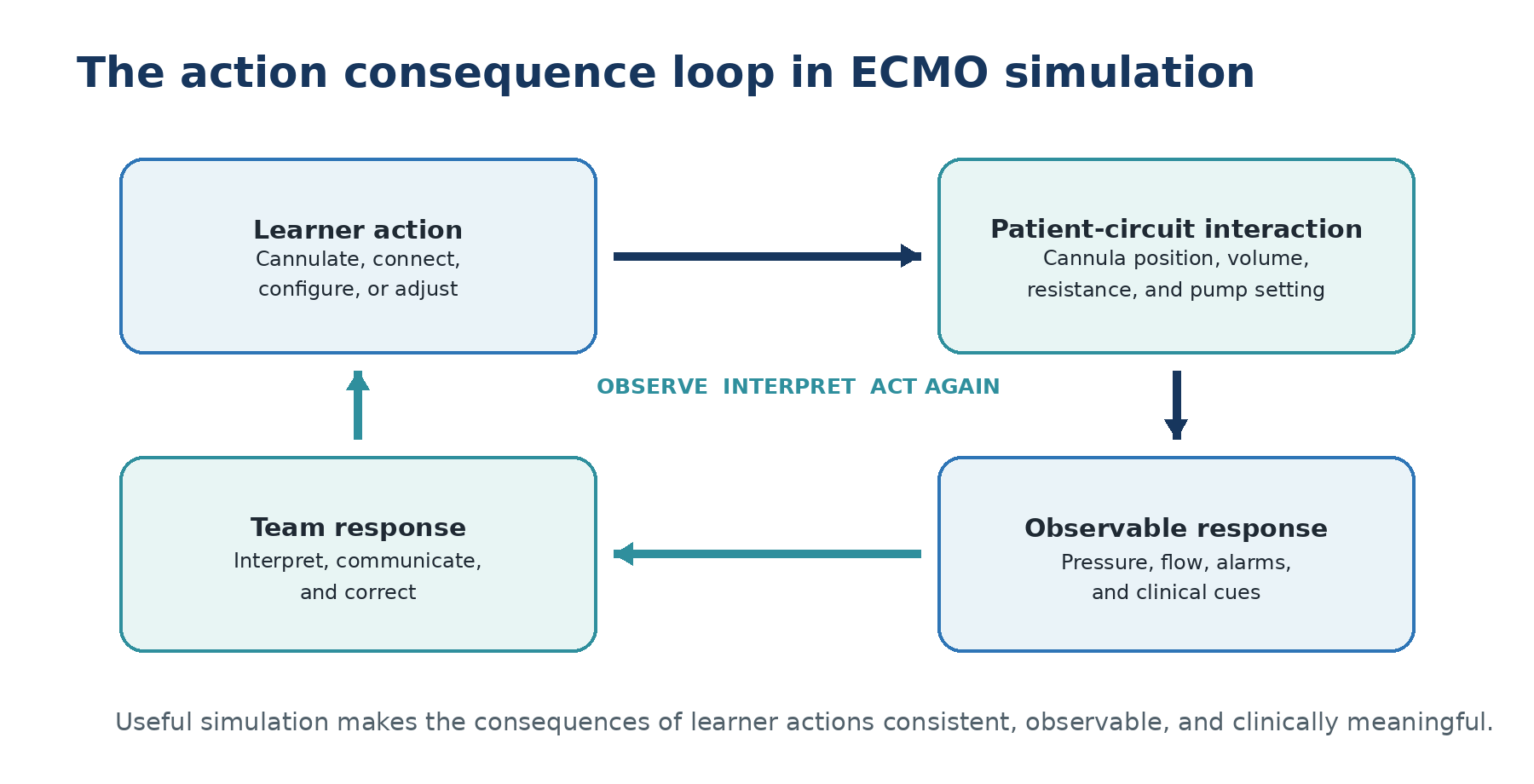
During ECMO support, pressure and flow are not isolated console values. They emerge from the interaction of venous return and volume status with cannula position, circuit resistance, configuration, and pump setting. Teams must interpret these signals together with patient findings and equipment behavior.
This is where a responsive patient-circuit system can add more value than a static cannulation model. An effective scenario allows the learner to observe a change, decide whether the likely cause lies in the patient, cannula, circuit, or equipment, intervene, and see whether the response is consistent with that decision. The platform does not need to reproduce every aspect of physiology, but the relationships selected for training should be stable, explainable, and repeatable.
Rare and time-critical events test the same underlying understanding. ELSO adult simulation requirements identify drainage insufficiency, air embolism, pump failure, membrane lung failure, and gas failure as essential scenarios. Neonatal and pediatric training may add events such as cannula dislodgement and circuit change. Some conditions can be generated through the physical platform; others may require instructor-controlled changes in vital signs, verbal cues, or a hybrid setup. What matters is that learners receive enough information to recognize the problem and that their response can be observed and discussed during debriefing.
Match the Platform to the Learner and Objective
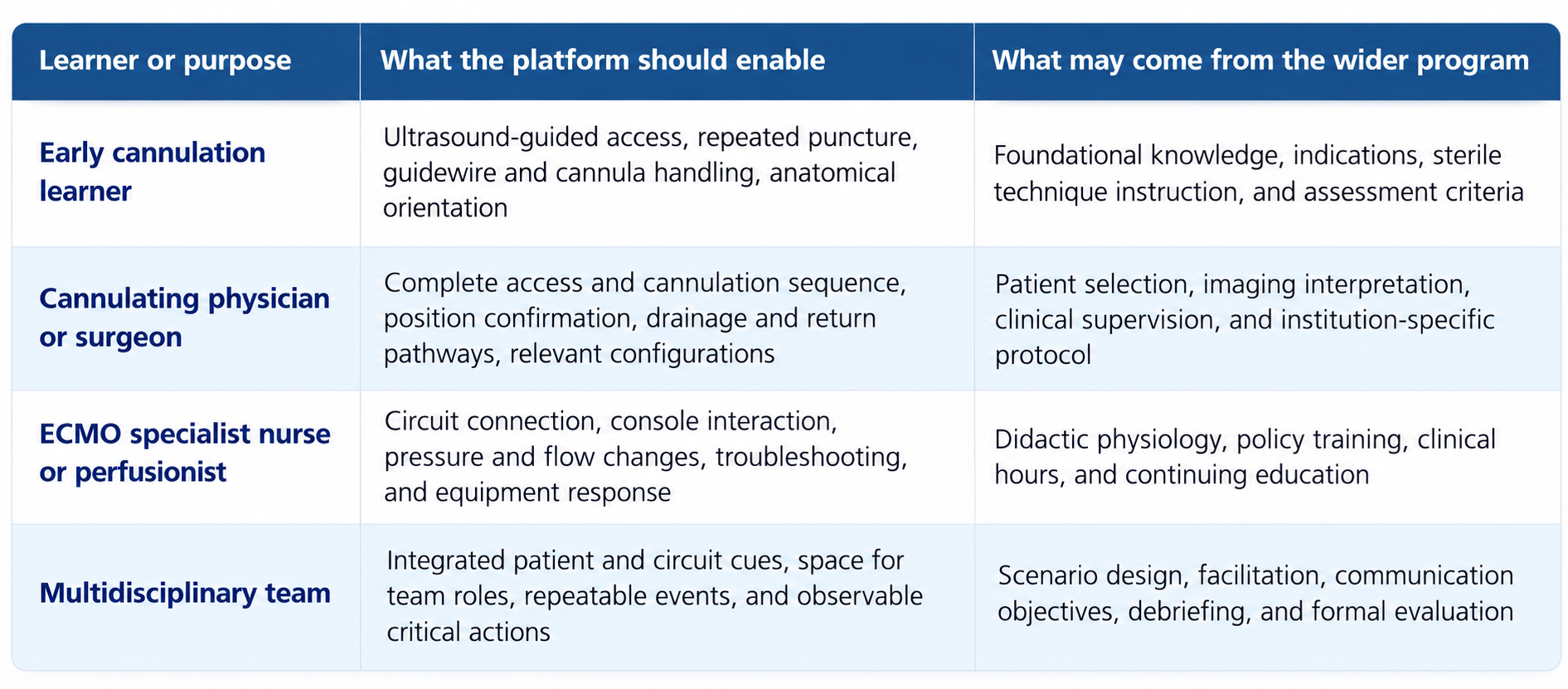
Selection should begin with the learner and the performance gap. Table 1 shows how platform requirements change across different learners and training objectives within the same program.
Operational fit matters alongside educational fidelity. Programs must consider the burden of acquisition, storage, maintenance, and day-to-day management over many training cycles. A modular design can keep the core patient-circuit system in service while punctured vessels and access components are replaced separately. New modules can then extend the platform to additional configurations or related procedures. In this sense, purposeful fidelity and modular versatility reinforce each other: realism is concentrated in the interactions that matter, while the surrounding system remains maintainable and adaptable. This reduces lifecycle burden and increases utilization without requiring a separate simulator for every objective.
For ECMO, however, integration should not become an excuse for an incomplete simulated patient. The physical platform should reproduce the relevant anatomy, access sites, circulatory pathways, equipment connections, and pressure-flow relationships that learners need to handle directly. It should also integrate cleanly with a manikin so the team works around a coherent patient rather than a collection of disconnected devices. Monitors, instructor controls, and scenario software can add displayed vital signs, alarms, and other cues, but they should complement rather than compensate for missing core patient-circuit interactions.
When Broader Endovascular Capability Adds Value
A platform designed for large-bore vascular access, guidewire and device interaction, and controlled circulation may also support selected endovascular curricula. Applications such as IABP or Impella insertion, hemodialysis access, REBOA deployment, or stent graft placement can increase utilization when they match the institution’s training needs. This versatility is an additional program benefit, not an ECMO competency requirement, and each procedure still requires its own anatomy, imaging, equipment, and learning objectives.
How EVAN and DORA Support the Program
The ECMO Cannulation and Endovascular Procedures Training Platform (EVAN) is an adult patient-circuit platform that connects ultrasound-guided cannulation and circuit initiation with pressure and flow behavior. Its three-dimensional vascular pathways reproduce clinically relevant device trajectories, including the aortic bifurcation into the common iliac arteries. Integrated systemic and pulmonary circulation, adjustable heart rate, aortic pressure, and central venous pressure, compatibility with clinical ECMO consoles, and replaceable vessels and access modules allow repeated practice across ECMO configurations and selected endovascular procedures.
The NeoPeds Endovascular Procedures Training Platform (DORA) applies the same approach to neonatal and pediatric training. Its age-appropriate vascular anatomy and hemodynamic settings influence access, guidewire navigation, cannula positioning, and ECMO or ECPR practice in ways that a scaled-down adult model may not reproduce.
Both platforms provide the physical and functional patient-circuit layer within a broader education program, without replacing supervised clinical practice. They help learners connect cannulation and circuit configuration with pressure, flow, equipment response, and team action, while modular components support maintenance and adaptation to different training objectives.
Choose the Platform Around the Learning Task
An ECMO simulator should be judged by the practice it makes possible. Programs should first define the learner and the performance to be assessed, then identify the patient-circuit responses and training frequency needed to support that practice. The simplest platform or combination of tools that preserves those relationships is usually the right choice.
For programs seeking to connect cannulation and circuit configuration with pressure and flow management, a responsive patient-circuit platform can provide the continuity that separate task trainers and abstract circuit exercises may not offer. That continuity is where simulation can turn repeated hands-on activity into better technical reasoning and team preparation.
Explore ECMO Simulation Platforms
Review the EVAN adult platform and the DORA neonatal and pediatric platform to determine whether their cannulation, circuit connection, circulatory, and modular capabilities match your program.
References and Further Reading
- Extracorporeal Life Support Organization. ELSO 2025 Narrative Guideline on ECMO Training and Continuing Education.
- Extracorporeal Life Support Organization. Adult ECMO Certification.
- Extracorporeal Life Support Organization. ECLS Center Certification Blueprint Level 3 Centers. Revised June 24, 2025.
- Duinmeijer WC et al. Simulators and Simulations for Extracorporeal Membrane Oxygenation. An ECMO Scoping Review. Journal of Clinical Medicine. 2023;12:1765.
- SurgMate. ECMO Cannulation and Endovascular Procedures Training Platform (EVAN).
- SurgMate. NeoPeds Endovascular Procedures Training Platform (DORA).