

"A practical guide to recognizing meaningful gaps, choosing the right customization path, and evaluating a development partner"
Standard medical simulation models are often the fastest and most economical starting point when their anatomy, functions, equipment interfaces, and operating requirements already match the intended use.
Customization becomes worthwhile when a material mismatch prevents users from performing the target procedure, using the intended equipment, reproducing relevant anatomy, or running an activity efficiently and repeatedly. The aim is not maximum realism, but sufficient fidelity in the dimensions that determine success. The decision should begin with a defined performance gap rather than a preference for custom development itself.
Custom medical simulation is not one development path. Repeatable solutions for devices, procedures, programs, demonstrations, or testing differ from case-specific solutions built from an individual patient’s data. The two paths require different workflows, outputs, stakeholders, and review priorities.
When Standard Models Stop Fitting the Application
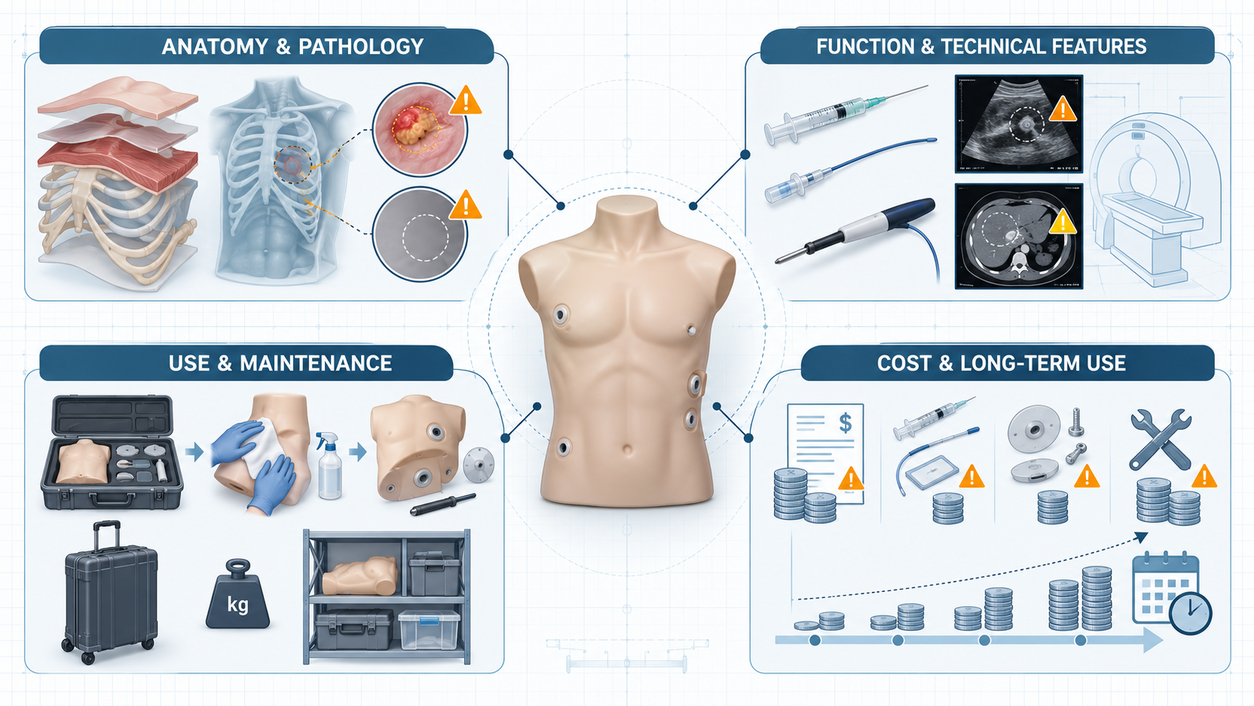
A standard model becomes a poor fit when its limitations affect the quality, efficiency, feasibility, or economics of the intended activity. Most important gaps fall into four categories.
| Type of mismatch | What it may look like | Why it matters |
|---|---|---|
| Anatomy and pathology | The anatomy is too simple or complex; the required lesion is absent; or geometry, variation, and spatial relationships do not fit the intended use. | An incorrect pathway or target can change the procedure and device behavior. |
| Function and technical features | The model cannot support the required puncture, cannulation, catheterization, suturing, ablation, imaging modality, energy source, instrument, or device. | Appearance alone is insufficient when users cannot perform the intended task with actual equipment. |
| Use and maintenance | Setup, reset, cleaning, storage, maintenance, or transport is difficult. Size, weight, fragility, or operating steps may not suit the site or team. | Operational friction reduces throughput, consistency, adoption, and user experience. |
| Cost and long-term use | Purchase price or total ownership cost is too high for the essential functions, including consumables, replacement parts, maintenance, shipping, and facilitator time. | Needs-based design and replaceable modules may improve lifetime value and production economics. |
A one-off custom model usually costs more to develop than an existing product, but it may provide better value when it removes irrelevant features, reduces recurring costs, improves throughput, replaces repeated workarounds, or supports a production volume that changes unit economics.
Typical triggers include a new medical device, proprietary workflow, training program, product demonstration, R&D activity, usability evaluation, or unsupported procedure. Even then, the team should first determine whether an existing platform can be configured or modified. The remaining gap should justify customization.
For device testing, the model’s role must be explicit. Internal development, demonstration, and formal verification or validation require different evidence, documentation, and controls.
Two Paths for Custom Medical Simulation
Custom medical simulation includes two distinct paths: Contract Design and Manufacturing Service (CDMS) for repeatable, requirement-driven applications, and Patient-Specific Simulation (PSS) for solutions driven by an individual patient and clinical question.
| Dimension | CDMS | PSS |
|---|---|---|
| Primary purpose | Develop a repeatable solution for a device, procedure, training program, demonstration, or test application. | Represent anatomy and pathology relevant to one patient and a defined clinical question. |
| Main stakeholders | Medical device product, R&D, education, marketing, and sales teams; hospitals and training institutions. | Clinicians, hospitals, care teams, and contributors to the case and review process. |
| Starting inputs | Device, procedure, workflow, users, environment, quantity, budget, schedule, and performance requirements. | Patient imaging, target anatomy or pathology, planned intervention, intended use, and clinician requirements. |
| Typical outputs | A training platform, demo kit, test bench, or other simulator delivered as a prototype, one-off system, or production run. | A case-specific virtual model, physical model, or hybrid solution for visualization, planning, communication, or procedural rehearsal. |
| Validation emphasis | Device interaction, function, usability, repeatability, manufacturability, deployment, and support. | Case-relevant anatomical accuracy, clinical review, intended function, data handling, and delivery timing. |
Contract Design and Manufacturing Service (CDMS)
CDMS is driven by a product or program requirement that must work across multiple users, events, sites, or production units. Medical device companies are the main customer group, although hospitals and training organizations may also commission specialized platforms.
Typical outputs include training platforms, demo kits, and test benches. A project may share components across these uses, but the requirements should remain distinct because repeated training, product demonstration, and technical testing impose different needs for usability, replacement, maintenance, documentation, and manufacturing.
Patient-Specific Simulation (PSS)
PSS is driven by an individual case. It commonly begins with two-dimensional CT or MRI images, often in DICOM format. Relevant anatomy and pathology are segmented and reconstructed into a three-dimensional digital model, then reviewed against the clinical question before the simulation format is selected.
The digital reconstruction is an essential foundation, but not necessarily the endpoint. A virtual model supports visualization, planning, communication, and AR/VR review.
A physical model becomes important when the question depends on tactile feedback, tissue handling, access, device delivery, anatomical deformation, spatial constraints, or rehearsal with real instruments.
A physical model can be held, viewed from different angles, used with actual equipment, and shared as a tangible reference across the clinical team. It may also reveal practical issues that remain difficult to judge on a screen. A hybrid solution extends this value by connecting hands-on interaction with digital overlays, navigation, sensing, or feedback while retaining a physical workspace. The appropriate format follows the clinical objective, and many cases may benefit from moving beyond visualization to physical or hybrid simulation.
Because PSS involves individual patient data, it requires different clinical stakeholders, data-handling practices, review requirements, and case-specific timelines from CDMS. Speed is especially important around a scheduled intervention, but not at the expense of anatomical accuracy or clinical confirmation.
How a Custom Medical Simulation Project Moves from Requirements to Delivery
Custom development converts clinical, technical, commercial, and operational needs into a design that can be built, tested, used, manufactured when required, and supported. A staged process makes assumptions visible and creates clear review points, even when phases overlap or repeat.
| Phase | Key work | Typical output |
|---|---|---|
| Requirements and feasibility | Clarify intended use, users, procedure, device, anatomy, quantity, budget, schedule, environment, and constraints; confirm feasibility. | Agreed scope and project inputs |
| Project alignment and conceptual design | Confirm user requirements; define anatomy, materials, system architecture, hardware and software, industrial design, interfaces, and modularity. | Requirements, drawings, and specifications |
| Prototype building and testing | Build the prototype; define acceptance criteria; test; obtain customer or clinician review; document findings. | Prototype and test results |
| Design refinement and manufacturing | Refine and approve the design; prepare manufacturing information; produce the agreed quantity; arrange delivery and support. | Approved design and final solution |
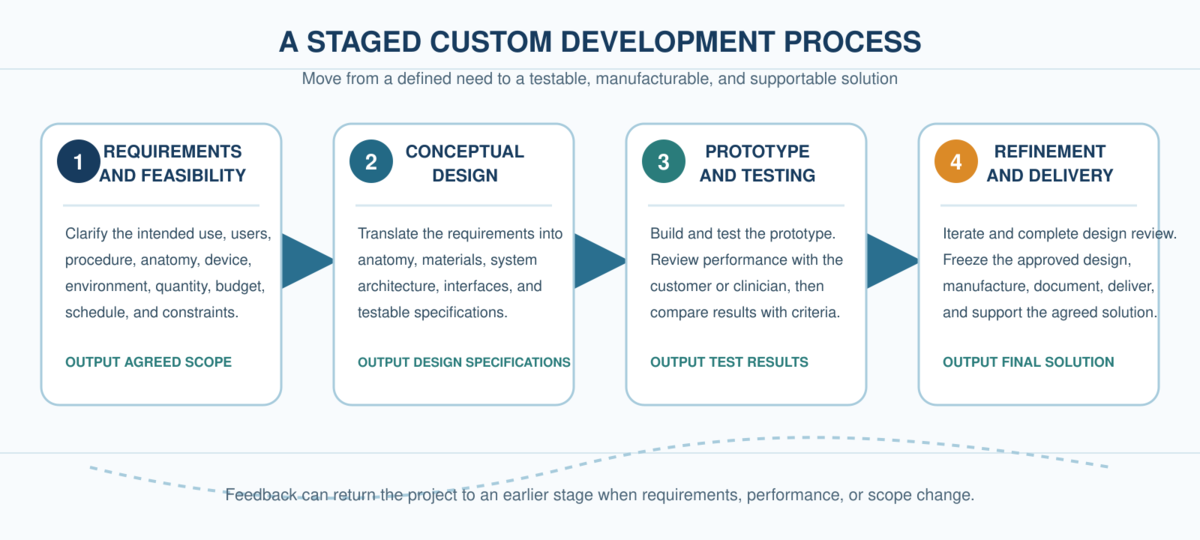
Documentation and testing should match the model’s intended role. Education or demonstration use does not automatically provide evidence for medical device verification, validation, regulatory submission, or clinical decision-making; those uses require an explicitly defined scope and appropriate controls.
A Purpose-Driven Approach to Custom Model Development
Custom does not mean maximum realism. Effective development begins with intended use, the critical dimensions of fidelity, and the risks or failure points that must be represented. Our guide to selecting medical simulation models examines these questions in detail; custom development translates the answers into testable requirements and acceptance criteria.
That translation is cross-disciplinary. Materials science shapes anatomy, tissue behavior, imaging, durability, and energy interaction. Hardware and software engineering enable flow, pressure, sensing, controls, feedback, and digital integration. Industrial design affects usability, setup, portability, maintenance, and storage. Clinical insights keep the solution aligned with the real procedure, users, workflow, and risks.
Purposeful fidelity treats appearance, anatomy, tissue response, imaging, physiology, device interaction, and operating context as separate design decisions. Reproduce what influences the intended result and simplify what does not. Use modularity when it improves repeatability, maintenance, adaptability, or lifetime cost.
Different applications require different fidelity. An arteriovenous malformation model may emphasize vascular geometry, flow, access, and navigation; a uterine fibroid ablation model may emphasize lesion position, imaging, access, and energy interaction; an aortic dissection model may emphasize lumen anatomy, catheter behavior, and deployment space. The task determines the design.
How to Choose a Development Partner
Before comparing providers, ask two threshold questions: does the partner have the technical capabilities to execute the work, and a clear process for managing the project? If both answers are yes, five practical factors help identify the best fit.
| Evaluation factor | What to look for |
|---|---|
| Experience and expertise | The ability to uncover unspoken needs, translate intended use into measurable requirements, integrate the required disciplines, and solve development challenges efficiently. Prior experience should produce better questions and faster problem solving, not simply credentials. |
| Service and collaboration | Attentiveness, enthusiasm, responsiveness, clear communication of tradeoffs, documented decisions, and ownership of agreed actions. A strong partner understands the customer’s context instead of waiting for every detail to be specified. |
| Quality and design sensibility | Quality includes anatomical and functional accuracy, durability, device compatibility, and manufacturing consistency. Design sensibility appears in choices of materials, form, finish, interface, scale, weight, and visual presence. In demonstration settings, the model should look professional and refined without overshadowing the medical device it supports. |
| Speed and delivery reliability | Timely feasibility feedback, prototyping, review cycles, refinement, and delivery. Speed is particularly important when PSS must support a scheduled intervention; predictable milestones and communication matter alongside lead time. |
| Price and total value | Transparent pricing assessed with scope, production quantity, consumables, maintenance, support, rework, delays, and lifecycle cost. The lowest initial quotation may cost more if unclear requirements or rework create avoidable expense. |
Regardless of how these factors are weighted, the process should be staged, testable, and transparent. Before work begins, both parties should clarify scope, responsibilities, acceptance criteria, intellectual property, change control, and future manufacturing or supply arrangements.
Standard or Custom: Choose the Right Starting Point
The first decision is whether customization is needed at all. Use a standard model when it supports the essential anatomy, function, equipment, workflow, and operating conditions. Configure an existing platform when the remaining gap is limited; move to custom development when the mismatch materially affects performance, usability, timing, or total value.
If customization is justified, identify its primary driver. A repeatable device-, procedure-, program-, demonstration-, or test-driven solution points toward CDMS. A need driven by one patient’s anatomy, pathology, and clinical question points toward PSS, with a virtual, physical, or hybrid output chosen for the intended use.
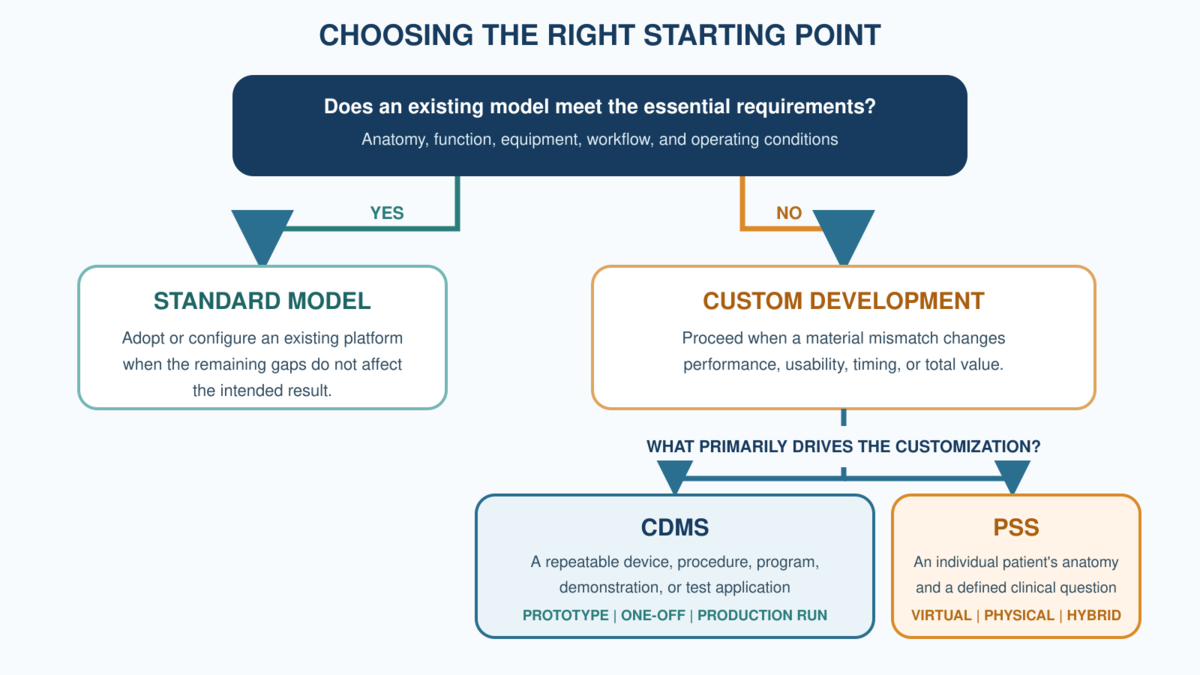
When a project combines repeatable and patient-specific elements, define the stable platform separately from the case-specific components so that each can be designed and reviewed for its own purpose.
From a Defined Need to a Fit-for-Purpose Solution
A useful custom medical simulation model begins with a defined mismatch and ends with evidence that the solution is fit for its intended use. Critical requirements, tradeoffs, testing, ownership, timing, and total cost should be visible before complexity accumulates.
SurgMate applies this approach through MED.ci, integrating Materials science, hardware and software Engineering, industrial Design, and clinical insights. Its Contract Design and Manufacturing Service supports repeatable training, demonstration, and testing applications, while Patient-Specific Simulation develops virtual, physical, or hybrid solutions for individual cases.
For a repeatable device-, procedure-, program-, or application-driven project, explore SurgMate’s Contract Design and Manufacturing Service (CDMS). Patient-specific inquiries should begin with the clinical objective, anatomy of interest, available imaging, intended use, and required timeline.