

Training for thyroid nodule procedures begins with ultrasound-guided targeting, then develops the distinct skills needed to obtain a sample, aspirate cyst fluid, or perform ablation. A useful simulation session connects what learners see on the screen with how they move an instrument and judge its relationship to the target and nearby structures. It also gives instructors a repeatable way to observe performance and provide feedback.
For clinicians, educators, and medical device teams, the central task is to turn these requirements into exercises with clear endpoints. This article focuses on sampling and minimally invasive treatment of thyroid nodules, with ablation discussed primarily in the context of benign nodules. Patient selection, diagnosis, and supervised clinical experience remain part of the broader training pathway.
Why Thyroid Procedures Require Focused Training
The thyroid lies close to the trachea, esophagus, major vessels, and nerves. The posteromedial region near the tracheoesophageal groove deserves particular attention because of the recurrent laryngeal nerve. Often described as a danger zone or danger triangle, this region is one part of the anatomy that operators must evaluate; other vulnerable structures also matter.
In this confined space, an apparently small hand movement can change an instrument’s relationship to a nodule margin. Learners need to coordinate the ultrasound probe with the needle, electrode, antenna, or fiber used for their procedure. They must also recognize when the image no longer provides enough information to continue confidently.
Simulation allows an instructor to isolate these problems. A learner can repeat a difficult approach, adjust probe orientation, or rehearse stopping and reassessing without the pressure of completing a patient procedure. Exercises should connect technical execution with the reasoning behind it: why this target, why this path, and what observation would change the next action?
Defining the Scope of Thyroid Procedure Training
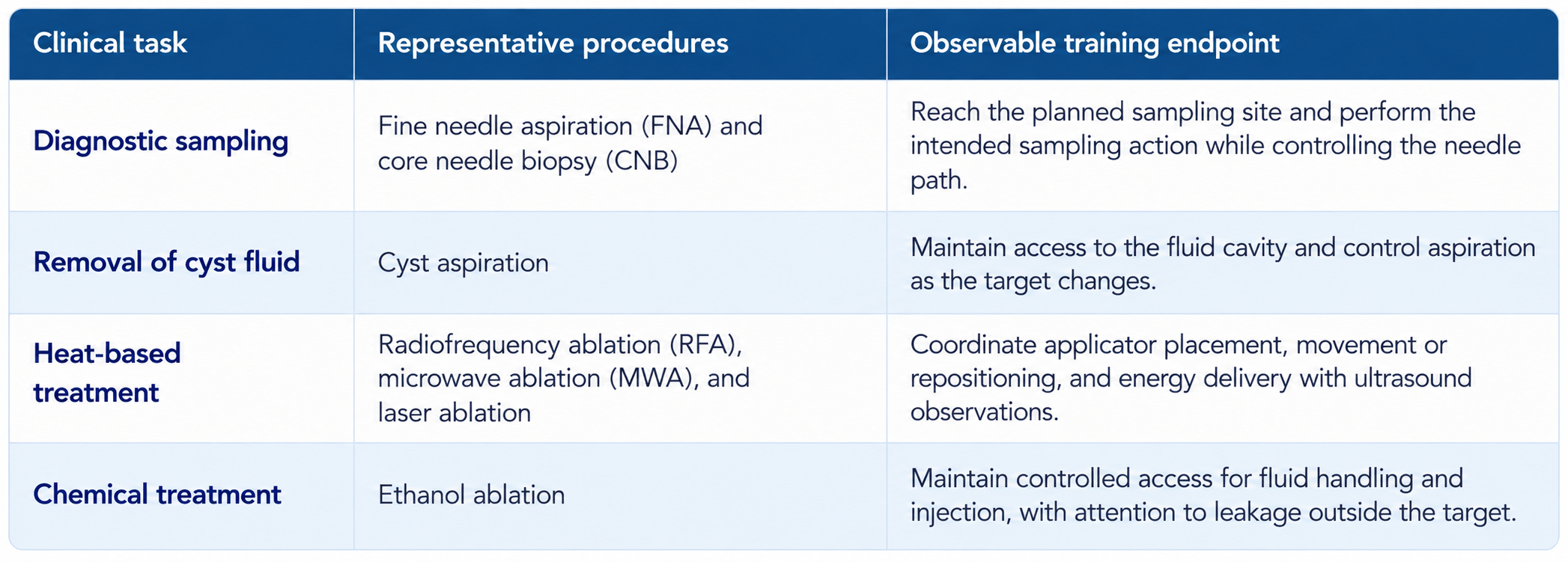
Sampling and treatment have different endpoints, even when they share instruments or basic ultrasound skills. Fine needle aspiration (FNA) obtains material for cytological evaluation, whereas core needle biopsy (CNB) retrieves tissue for histological assessment. Cyst aspiration removes fluid and may have a therapeutic purpose. Ethanol ablation has an established role in selected cystic or predominantly cystic nodules, particularly when fluid reaccumulates after aspiration.
Heat-based modalities, including radiofrequency ablation (RFA), microwave ablation (MWA), and laser ablation, share many training requirements, although their applicators and energy behavior differ. Cryoablation is also under investigation for thyroid nodules. A ten-patient pilot study published in 2026 adds preliminary evidence, while the thyroid-specific clinical evidence base remains comparatively limited.
Table 1 compares representative procedures by their clinical task and the performance an instructor can observe.
Table 1 Thyroid procedures and observable training endpoints
Developing Skills for Thyroid Procedures
Both sampling and ablation require target recognition, a planned approach, and coordinated probe and instrument handling. Instructors can establish these foundations before dividing practice into the two groups below. The exercise should make the intended target visible, allow instrument tracking, and provide a clear reason to stop, reposition, or continue.
Sampling and Cyst Aspiration
FNA practice should connect target selection with controlled needle movement and sample handling. Learners can rehearse maintaining the ultrasound view while positioning and manipulating a fine needle, then completing the handling steps used in their clinical setting. A model may support targeting and aspiration mechanics; cellular adequacy and diagnostic interpretation require additional teaching materials and assessment.
CNB adds a distinct spatial requirement. Learners must understand the sampling notch, the device’s firing distance, and the tissue that lies along that path. The exercise should make them check the planned sampling trajectory before deployment and maintain control during withdrawal. These requirements are reflected in thyroid CNB guidance, which emphasizes vessel mapping and evaluation of the firing route.
For cyst aspiration, the target may become smaller as fluid is removed. A suitable exercise asks learners to maintain access while coordinating the probe, needle, and syringe. If the model cannot reproduce cavity collapse, the instructor can still teach the handling sequence and use clinical images to explain how the target changes.
These exercises can share an initial positioning task while retaining separate endpoints. Reaching a nodule is only one part of sampling. An instructor also needs to observe whether the learner performs the intended action with controlled instrument movement and understands how the resulting material will be assessed.
Ablation Techniques and Protection of Adjacent Structures
Ablation practice also requires learners to control where energy is delivered within the nodule. Learners need to relate applicator movement or repositioning to energy delivery, image changes, and the margin of the target. The applicator’s geometry and the equipment used in the course should inform the exercise.
The moving-shot technique organizes treatment into small units, with the applicator repositioned as treatment progresses. It is a standard technique in thyroid RFA training. The trans-isthmic approach addresses a different question: the route used to reach the nodule. Teaching the two together can connect entry planning with controlled treatment inside the target.
The fluid-motion technique emphasizes continuous, controlled applicator movement within the nodule during ablation. Published clinical studies describe combined thermal and mechanical disruption, with reports extending from an initial series to a multicenter study. These studies provide clinical examples in thyroid MWA. In training, the useful focus is coordination of ongoing movement, energy application, and ultrasound observation. The movement pattern should be taught with the operating characteristics of the device being used.
Protective methods belong alongside applicator control. Hydrodissection creates separation between a target and adjacent vulnerable structures. Advanced artery-first ablation and marginal venous ablation address aspects of nodule blood supply and heat loss. These methods add learning objectives involving fluid placement or vascular anatomy; they should be introduced with suitable supervision and supporting imaging.
A course can combine hands-on practice with clinical images and demonstrations. Practicing hydrodissection requires a model that allows fluid to separate the relevant layers. Exercises involving vascular anatomy can use static structures for orientation, while teaching the heat-sink effect requires an explanation or representation of blood flow and heat transfer.
Laser ablation and ethanol ablation also need exercises appropriate to their delivery systems. Laser training addresses fiber placement and coverage of the intended treatment area. Ethanol training emphasizes controlled access, aspiration where indicated, injection, and recognition of possible leakage. Shared ultrasound skills provide a foundation, while equipment and treatment mechanism determine the remaining steps.
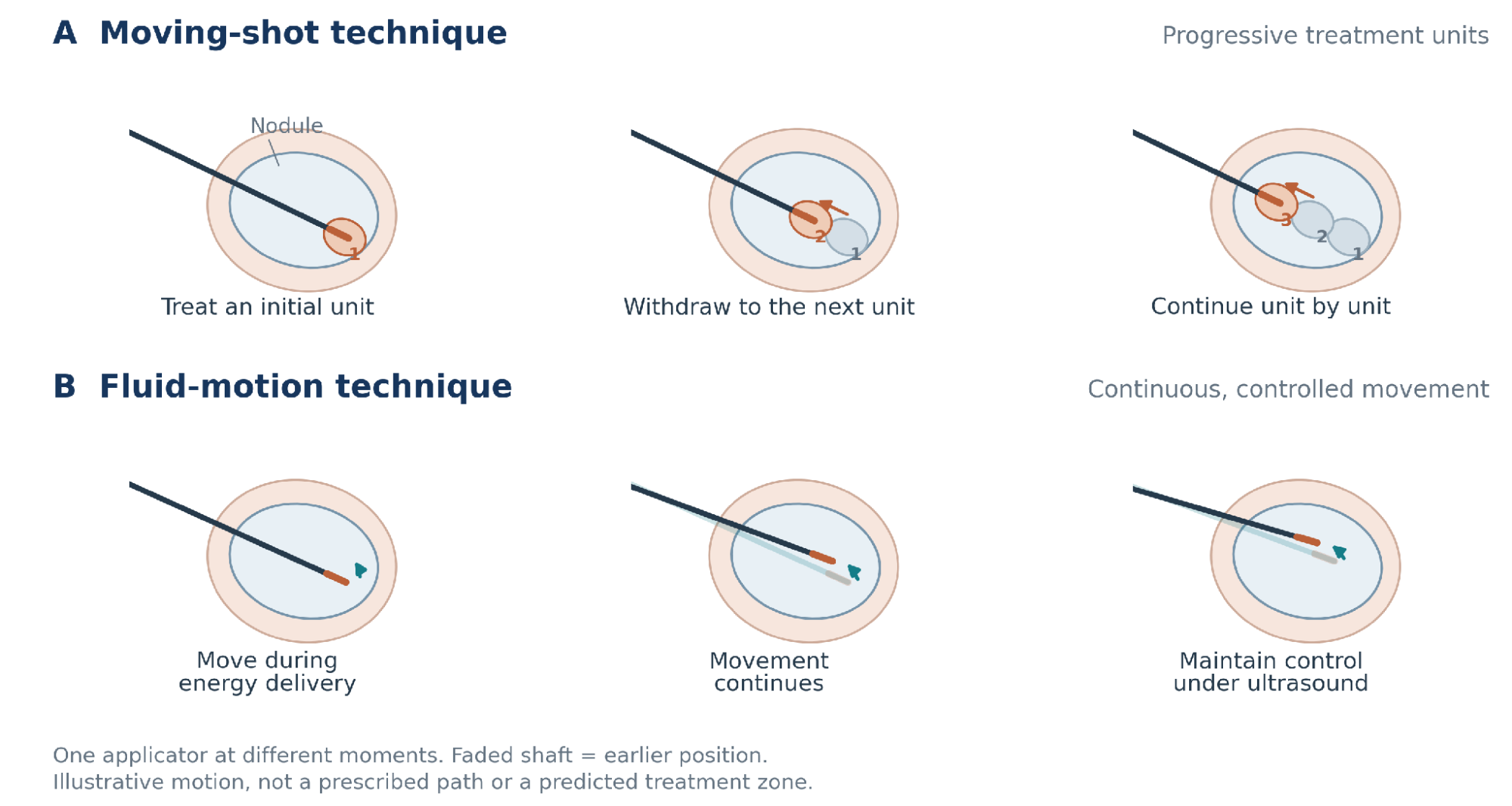
Figure 1. Moving-shot progresses through small treatment units; fluid-motion maintains continuous, controlled applicator movement during ablation. These schematic snapshots illustrate concepts rather than prescribed trajectories or predicted treatment zones.
Turning Practice into Observable Feedback
Assessment becomes more useful when instructors describe specific actions. A targeting exercise can record whether the learner identifies the intended structure, explains the approach, and keeps the instrument tip visible on ultrasound. An ablation exercise can add observations of applicator control and the learner’s response when the view becomes obscured or a temperature alert occurs.
Temperature feedback can help learners relate energy delivery to changes near a monitored region. An alert can prompt them to pause, reassess the ultrasound image and instrument position, and explain their next action.
However, a temperature reading reflects conditions only at the sensing location. It does not establish the temperature throughout the target, demonstrate complete ablation, or determine whether clinical nerve injury would occur. Similarly, an echogenic change in a model can support observation and discussion without proving that the entire intended volume has been treated. Instructors should connect each feedback signal to the specific learning objective it can support.
Published training experience supports combining repeated model practice with supervised clinical learning. A 2022 study used chicken hearts as nodule targets in a food-based model for three trainees, followed by clinical participation under supervision. This experience illustrates how model practice can precede patient procedures, although the small, uncontrolled study limits conclusions about training effectiveness.
For course design, a practical progression is to begin with an observable handling task, provide focused feedback, and repeat the task with a change in target or approach. Later exercises can introduce a loss of visibility or an instructor-provided complication cue. Debriefing should examine both the action and its rationale. Evidence of consistent performance can inform progression within a program, alongside the clinical supervision and assessment required by that institution.
How SurgMate Supports Thyroid Procedure Training
SurgMate’s Thyroid Nodules Biopsy and Ablation Training Platform, model THY-B01A, provides modular thyroid pads for ultrasound-guided sampling and ablation practice. Options include pads for FNA, CNB, ethanol ablation, and energy-based ablation, with 2 cm and enlarged 3.2 cm nodule configurations available for relevant exercises. Ultrasound-visible features include the thyroid, nodules, trachea, and vascular structures. The platform can also reproduce a hyperechoic cloud during ablation.
Embedded temperature sensors near the simulated recurrent laryngeal nerve region provide an alert at a single threshold selected for the exercise.
Replaceable pads support preparation for subsequent learners, while a portable case supports courses and workshops away from a fixed simulation room. Instructors can use the platform for observed practice and debriefing, with the selected pad and intended equipment matched to the exercise. Specialized device or workflow requirements can also be discussed through SurgMate’s Contract Design and Manufacturing Service (CDMS).
Connecting Simulation with Clinical Learning
Thyroid procedure training should give learners a clear task, a visible basis for judging their actions, and an opportunity to improve through feedback. Sampling and ablation can share ultrasound and instrument-control foundations while developing their distinct procedural skills. Incorporating moving-shot and fluid-motion concepts, protective methods, and well-defined feedback keeps practice connected to the demands of the procedure.
Explore SurgMate’s Thyroid Nodules Biopsy and Ablation Training Platform, or contact the team to discuss the procedures, instruments, and course objectives you want to support.
References and Further Reading
- Sinclair CF, et al. General Principles for the Safe Performance, Training, and Adoption of Ablation Techniques for Benign Thyroid Nodules: An American Thyroid Association Statement. Thyroid. 2023;33:1150–1170.
- American Thyroid Association. Fine Needle Aspiration Biopsy of Thyroid Nodules.
- Jung CK, et al. 2019 Practice guidelines for thyroid core needle biopsy. Journal of Pathology and Translational Medicine. 2020;54:64–86.
- Korean Society of Thyroid Radiology. Ethanol Ablation of the Thyroid Nodules: 2018 Consensus Statement. Korean Journal of Radiology. 2019.
- Ha EJ, et al. Radiofrequency ablation of benign thyroid nodules: recommendations from the Asian Conference on Tumor Ablation Task Force. Ultrasonography. 2021;40:75–82.
- Aliberti C, et al. Microwave ablation for large benign thyroid nodules: a proposal for a new approach: “the fluid-motion technique”. Updates in Surgery. 2024;76:239–244. Published online 2023.
- Two-year clinical outcomes of microwave ablation for benign thyroid nodules: results from a multicenter study. European Journal of Endocrinology. 2025.
- Korean Society of Thyroid Radiology. 2017 Thyroid Radiofrequency Ablation Guideline. Korean Journal of Radiology. 2018;19:632–655.
- Ultrasound-Guided Cryoablation of Benign Thyroid Nodules: 10-Patient Pilot Study with 12-Month Follow-up. Journal of Vascular and Interventional Radiology. Published online August 19, 2026.
- Li YR, et al. Successful Applications of Food-Assisted and -Simulated Training Model of Thyroid Radiofrequency Ablation. Frontiers in Endocrinology. 2022;13:809835.
- SurgMate. Thyroid Nodules Biopsy and Ablation Training Platform, THY-B01A.
- Shin JH, Baek JH, Ha EJ, Lee JH. Radiofrequency Ablation of Thyroid Nodules: Basic Principles and Clinical Application. International Journal of Endocrinology. 2012;2012:919650.
- Yusuf GT, et al. Application of contrast-enhanced ultrasound to improve the management of microwave thyroid nodule ablation. Ultrasound. 2026.
- Park HS, et al. Thyroid Radiofrequency Ablation: Updates on Innovative Devices and Techniques. Korean Journal of Radiology. 2017;18:615–623.